


CANNABIS COMPLYANCE
GROW YOUR BUD & BRAND
Get high on…
margins &
sustainability
How does Pop Top Lock help my business and the environment?…
margins
Pop Top Lock is designed to support stronger margins than alternative solutions that require a higher MSRP due to complex, plastic-heavy designs and limited viable alternatives. These legacy systems continue to dominate market share largely due to a lack of sustainable innovation in the category. In addition, PTL eliminates the need for additional labor associated with secondary protective components that must be applied after a traditional SOT (Stay-On-Tab) is affixed.
sustainability
Cannabis drinks are required to utilize a can end that meets Consumer Product Safety Commission (CPSC 16 CFR § 1700.20) guidelines. Pop Top Lock is designed to meet reseal, tamper-evident, and child-resistant requirements while also prioritizing sustainability with an all-aluminum end that is fully recyclable. The closure includes a food-safe BPA-NI polymer liner that comes into contact with the beverage but contains no additional plastic components.
Cannabis Brands want
cost-effective & all-aluminum options
Pop Top Lock delivers
State & Federal Compliance
All Aluminum Reseal
Reuse
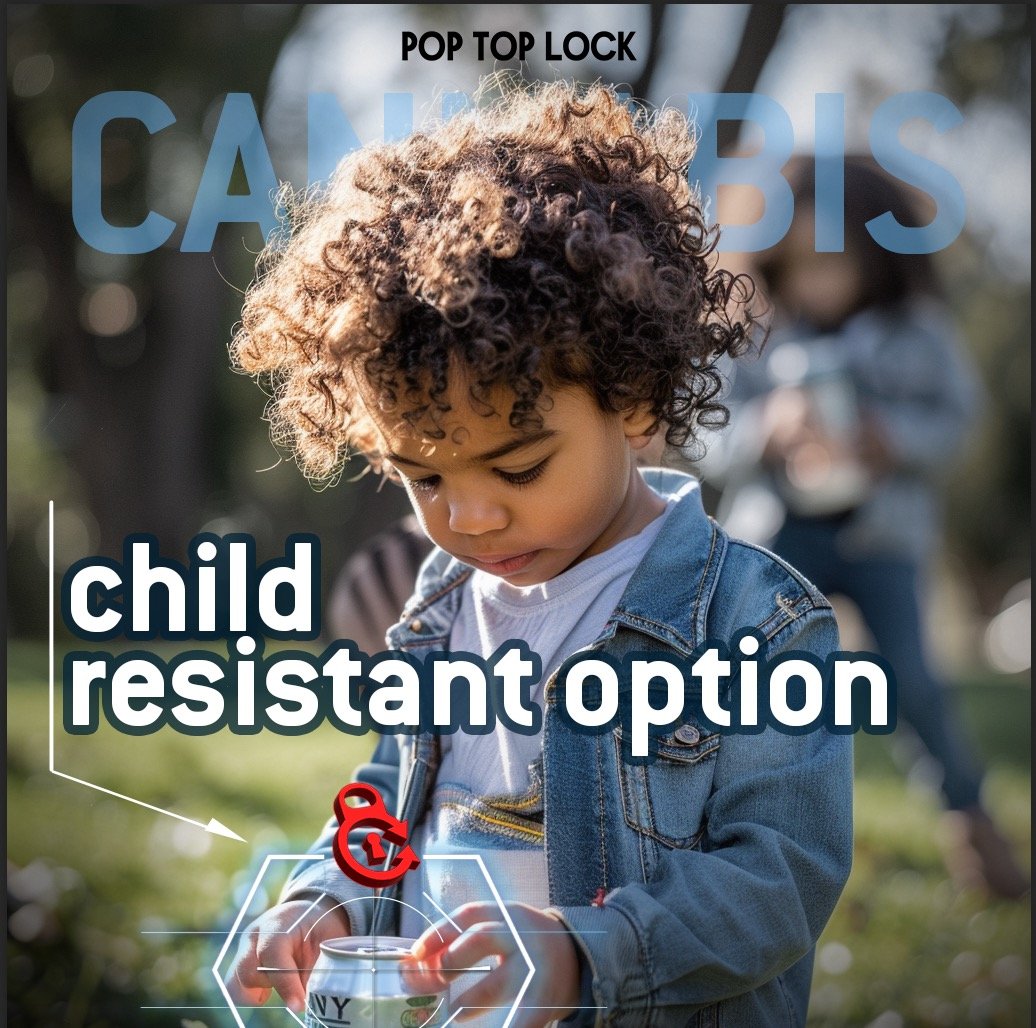
Protect children
Higher Margins
Adult friendly
Add to a sustainable planet
202 Double Edge Seam
Stackable

WAITLIST REQUESTS CLICK HERE
There will be a limited amount of ends produced in the first year so please contact us to get on the priority waitlist.
*Pricing of Pop Top Lock can end and specs are subject to change as Pop Top Lock develops because of the extremely competitive nature of this product. Images will be posted once Pop Top Lock is in the market. For all questions or investor inquiries please contact us at Contact@PopTopLock.com.
All details are subject to change as the Pop Top Lock project develops.
Pop Top Lock Child Resistant can end is the only all-aluminum, reclosable, reusable, 100% aluminum/100% recyclable can end on the market. It can be attached to any size can end with a double-edge seam, and can be likened to a 202 can end. The lining is the highest grade, consumable, and safe sealant that would be on a standard can end.
Pop Top Lock Child Resistant Overview:
Child Resistant
Tamper evident.
FDA & DCC regulation compliant.
SOT: Aluminum ends with a Stay-On Tab (SOT).
Stay-On Closure.
100% Aluminum.
100% Recyclable.
Reclosable.
Reusable.
Leak-free.
Holds carbonation.
Opens like a traditional pop top can end.
Uses a standard double-edge seam to attach to an aluminum can body.
Lining: BPANI Gen 2 (BPA-free).
Stackable.
Measurements: coming soon.
Filling requirements: coming soon.
Weight: coming soon.
Pallet/Sleeve size and weight: coming soon.
Please scroll down to see more details.
Why do THC Infused Drinks use a expensive plastic closure?…
That’s all there is… until Pop Top Lock.

Currently, there is no other all-aluminum SOT can end that is 100% fully recyclable and meets the federal and state requirements for Cannabis drinks; child-resistant, tamper-evident, and reclosable.
Cannabis beverage makers are forced to use costly plastic CR/TE ends due to a lack of alternatives, compromising their sustainability goals. These plastic closures increase environmental waste and risk valuable aluminum being lost, as some recycling facilities reject cans with plastic components. With the cannabis-infused drink market expanding rapidly, this issue is only becoming more urgent.
Pop Top Lock Cannabis design finally gives Manufacturers the choice to use fully recyclable cans that have a cheeper MSRP and they help lower plastic into the environment - becoming part of the solution to plastic that winds up in landfils or the ocean.
The Problem with Mixed-Material Packaging
Recycling facilities are primarily designed to process single-material items. When materials like plastic and aluminum are fused together, they become difficult to separate efficiently. This complexity often leads facilities to divert such items to landfills rather than attempt costly separation processes.
For instance, Tetra Pak cartons consist of approximately 75% paperboard, 20% plastic, and 5% aluminum. While the paper component is recyclable, the bonded plastic and aluminum layers, known as poly-aluminum, are challenging to process and frequently end up as waste.
Previously developed resealable cans often incorporated plastic components in their closures, further complicating recyclability and reducing the likelihood that they’ll be recovered in standard aluminum recycling streams.

Pop Top Lock is a global solution
for sustainable packaging the cannabis industry to
reduce plastic pollution,
stop unnecessary aluminum waste,
save millions, eventually billions of dollars in aluminum loss,
and reduce manufacturing production costs.
*Promote Recycling and Lower Brand COG*
Recycling aluminum helps stabilize the wholesale price of cans by reducing reliance on newly mined material, avoiding issues like the aluminum shortage that occurred during the COVID-19 pandemic in 2020, when demand for canned beverages surged and supply chains were disrupted. Recycling also reduces unnecessary CO₂ emissions and the high costs associated with mining virgin aluminum.
The demand for aluminum continues to grow, particularly in the beverage sector. THC-infused drink sales are projected to grow globally at a CAGR of 5.6% through 2026, and SkyQuest projects the aluminum can market will reach $87.1 billion by 2030.
To maintain healthy profit margins, beverage brands must ensure a steady, cost-effective aluminum supply. Recycling supports this by reinforcing the circular economy and strengthening manufacturers’ bottom lines—ultimately keeping costs of goods lower for suppliers and producers alike.