


Pop Top Lock sustainable attributes:
Reduce Transportation emissions: Aluminum is up to 15 times lighter than glass, and Pop Top Lock’s reusability helps cut global shipping and cargo weight.
Reduce Energy Production:
Using recyclable aluminum instead of plastic or raw bauxite saves energy, reduces plastic waste, and lowers oil and gas use, methane, and CO2 emissions.
Stop Ocean Plastic Pollution:
Heal marine life and our food chain, reduce microplastics and ocean acidification that leads to global warming.
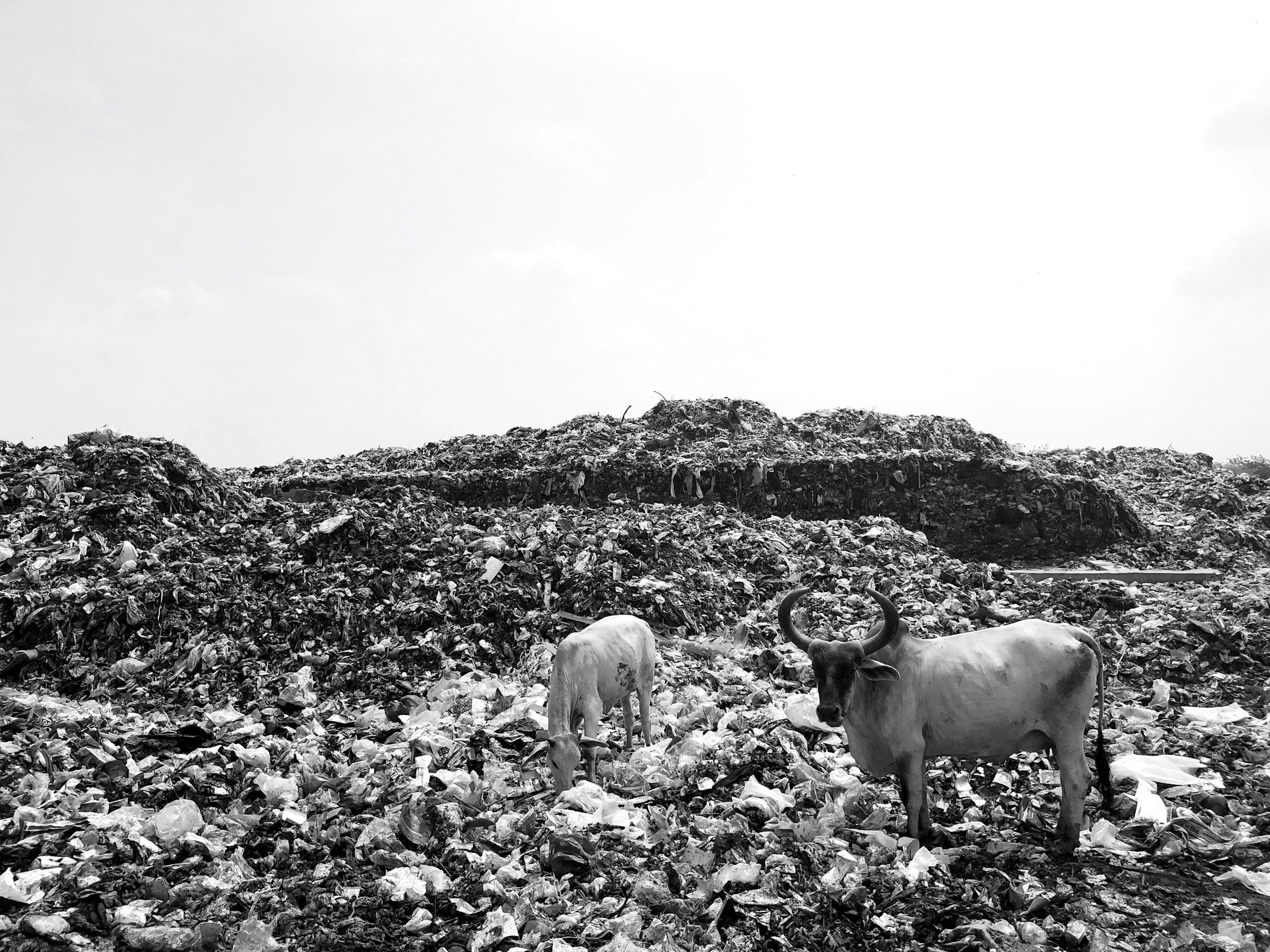
Landfill waste & Methane gas:
Recycling and reusing cans reduces methane emissions, wildlife harm, leachate formation, and landfill overcrowding.


WAITLIST REQUESTS CLICK HERE
There will be a limited amount of ends produced in the first year so please contact us to get on the priority waitlist.
*Pricing of Pop Top Lock can end and specs are subject to change as Pop Top Lock develops because of the extremely competitive nature of this product. Images will be posted once Pop Top Lock is in the market. For all questions or investor inquiries please contact us at Contact@PopTopLock.com.
All details are subject to change as the Pop Top Lock project develops.
Pop Top Lock can end is the only all-aluminum, reclosable, reusable, 100% aluminum/100% recyclable can end on the market. It can be attached to any size can end with a double-edge seam, and can be likened to a 202 can end. The lining is the highest grade, consumable, and safe sealant that would be on a standard can end.
Pop Top Lock - Classic Design Overview:
SOT: Aluminum ends with a Stay-On Tab (SOT).
Stay-On Closure.
100% Aluminum.
100% Recyclable.
Reclosable.
Reusable.
Leak-free.
Holds carbonation.
Opens like a traditional pop top can end.
Uses a standard double-edge seam to attach to an aluminum can body.
Lining: BPANI Gen 2 (BPA-free).
Stackable.
Measurements: coming soon.
Filling requirements: coming soon.
Weight: coming soon.
Pallet/Sleeve size and weight: coming soon.
Please scroll down to see more details.
Pop Top Lock has two designs - both are all-aluminum, resealable and reusable.
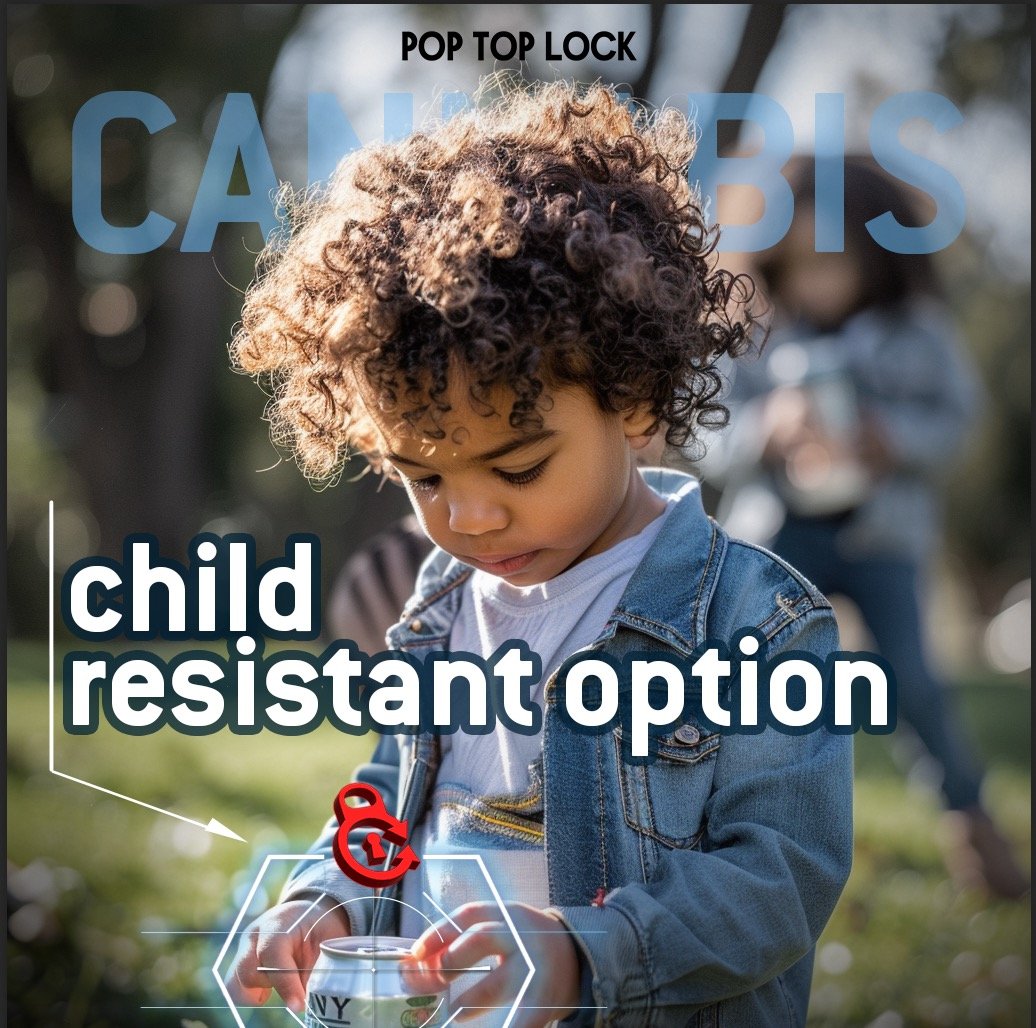
Pop Top Lock Cannibus design is Tamper-Evident & Child-Resistant to comply with state and federal laws and to keep children safe.

WAITLIST REQUESTS CLICK HERE
There will be a limited amount of ends produced in the first year so please contact us to get on the priority waitlist.
*Pricing of Pop Top Lock can end and specs are subject to change as Pop Top Lock develops because of the extremely competitive nature of this product. Images will be posted once Pop Top Lock is in the market. For all questions or investor inquiries please contact us at Contact@PopTopLock.com.
All details are subject to change as the Pop Top Lock project develops.
Pop Top Lock Child Resistant can end is the only all-aluminum, reclosable, reusable, 100% aluminum/100% recyclable can end on the market. It can be attached to any size can end with a double-edge seam, and can be likened to a 202 can end. The lining is the highest grade, consumable, and safe sealant that would be on a standard can end.
Pop Top Lock Child Resistant Overview:
Child Resistant
Tamper evident.
FDA & DCC regulation compliant.
SOT: Aluminum ends with a Stay-On Tab (SOT).
Stay-On Closure.
100% Aluminum.
100% Recyclable.
Reclosable.
Reusable.
Leak-free.
Holds carbonation.
Opens like a traditional pop top can end.
Uses a standard double-edge seam to attach to an aluminum can body.
Lining: BPANI Gen 2 (BPA-free).
Stackable.
Measurements: coming soon.
Filling requirements: coming soon.
Weight: coming soon.
Pallet/Sleeve size and weight: coming soon.
Please scroll down to see more details.


Pop Top Lock reuse for a global impact

Reusing 5% | CO2 Emissions: global transport is reduced by 4.8 million tons annually.
This is equivalent to removing 930,000 cars from the road.Reusing 5% | Energy savings: 3.89 billion kWh annually. Enough energy to power 380,000 U.S. homes annually.
Reusing 5% | Beverage waste reduction: Billions of liters saved annually.
Reusing 5% | Aluminum Raw Mining:
5% of the raw bauxite needed yearly saves 277,500 tons a year of aluminum.
Prevents environmental harm and resource depletion.
Saves 1.17 billion kWh of energy annually. Equivalent to powering 105,000 U.S. homes for a year.
Saves approximately 1.33 million tons of CO₂ emissions annually. Driving 290,000 cars for a year. To absorb that same amount of CO₂, you’d need about 22 million tree seedlings growing for 10 years.
Reusing 5% | Trash Collection Savings:
$15 million in collection and disposal costs saved annually.
If municipalities save money, taxpayers could benefit from reduced waste management fees or stabilized local taxes.
Businesses also save on waste collection and disposal costs.
Additionally, reusing cans reduces landfill space and prevents waste leakage, indirectly reducing environmental cleanup costs.
Recycling aluminum saves 95% of the energy required to produce aluminum from bauxite. Pop Top Lock’s commitment to recycling edcuation, our goal, will approximately save 5% of aluminum gone to landfills:
492 billion kWh of energy per year. Equivalent to powering 2.2 million U.S. homes for a year.
CO2 emissions avoided: 4.3 million tons annually. This is equivalent to removing 930,000 cars from the road annually.
Landfill waste reduced: 277,500 tons/year. Organic waste in landfills decomposes and produces methane (CH4), a greenhouse gas 25 times more potent than CO2 in trapping heat in the atmosphere.
This will avoid about 6.9 million tons of CO2 equivalent emissions (25 x 277,500 tons of methane). Equivalent to planting about 31.5 million trees and letting them grow for 10 years or removing approximately 1.5 million cars from the road for an entire year.

GLOBAL EMISSIONS BIG PICTURE
CONTRIBUTORS & IMPACT
Major Contributors to Global Warming:
Plastic production and recycling account for 2% of global GHG emissions, similar to the contribution of aviation. However, plastics’ broader environmental impact (e.g., pollution, microplastics, ocean disruption) makes it a significant issue beyond climate change. Unlike aviation, plastics’ impact contributes to environmental pollution and microplastic contamination. By 2050, this is projected to grow to 15% of the global carbon budget if no significant changes are made.
Plastic bottles (and caps) account for about 12-14% of global plastic production.
Globally, 9% of all plastic waste is recycled.
In 2021, Coca-Cola, PepsiCo, and Nestlé alone were responsible for 23% of branded plastic pollution globally, according to the Break Free From Plastic Movement.
Aviation contributes about 2-3% of global CO2 emissions.
Private aviation accounts for a small fraction (1-2%) of total aviation emissions, but its disproportionate impact is significant given its limited accessibility.
Energy Production (Electricity and Heat): Responsible for about 25% of global GHG emissions due to burning coal, oil, and natural gas.
Producing polyethylene terephthalate (PET), the primary material in beverage bottles, is energy-intensive. About 4% of global oil and gas production is used for plastic production, with the beverage sector consuming a significant share.
Agriculture and Land Use: About 18-20%, from deforestation, livestock (methane emissions), and fertilizer use.
Industry: Around 21%, from cement production, chemical manufacturing, and steelmaking.
Transportation: Roughly 14-16%, including cars, trucks, ships, and planes (aviation as a subset).
Buildings: About 6%, primarily from heating and cooling systems.
The broader fight against global warming depends on addressing the systemic emissions from energy, agriculture, and transportation that form the bulk of the problem. ↓
We will impact global emissions, together.

